
Walk through any city street and start counting logos at eye level. On a given day, more of them will be sitting on caps than staring down from billboards.
That’s the appeal for marketers. A branded cap costs a few dollars, survives years of wear, and keeps advertising long after a paid campaign runs out of budget. A digital ad disappears the moment someone scrolls past it. A cap doesn’t.
Custom wear , apparel and accessories printed or embroidered with a logo , covers everything from t-shirts to jackets, but caps punch above their weight within that category. They’re cheap enough for a startup to hand out at a farmers market and premium enough for an established brand to sell as lifestyle merchandise customers are proud to wear.
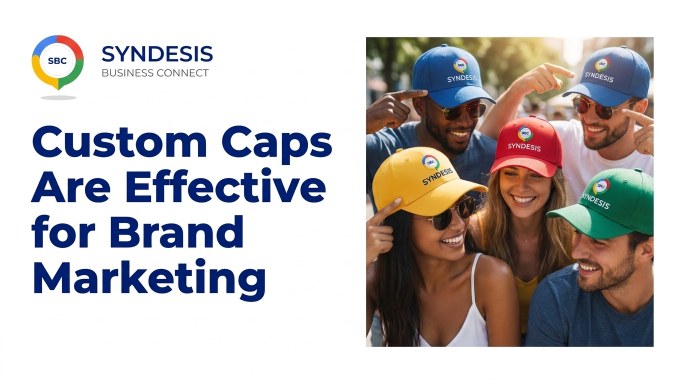
That’s exactly why caps work for two very different audiences. If you’re a small business trying to get noticed on a limited budget, a branded cap turns every happy customer into a source of free, hyper-local visibility. If you’re a bigger, established brand, caps do something different: they turn loyalty into apparel people choose to wear on their own time, not just merchandise they take home and forget about.
As a wearable billboard, a cap earns something most advertising can’t: an emotional reaction. People don’t put a highway billboard on their head. They do put on a cap that says something about who they are , which is exactly why the brand attached to it benefits.

Why Custom Caps Are Powerful Marketing Tools
Turn Customers into Brand Ambassadors
Every time someone puts on your branded cap, they’re doing marketing work for you , for free, and without being asked.
This isn’t theoretical. Small businesses have leaned into it heavily over the past couple of years. Axios reported in 2026 that restaurants, coffee shops, and fitness studios are increasingly selling merch instead of just their core product, treating hats and hoodies the way streetwear brands treat drops. Call Your Mother, a D.C.-born bagel shop, built a swag shop and a following of nearly 100,000 on Instagram partly by making customers want to wear the brand, not just eat there. Cafe Aroma, a coffee brand that started as a family business roasting beans on a stovetop and is now stocked at Walmart, sells caps and sweatshirts styled after its own archival photos. Its vice president, Bernadette Gerrity, put the appeal in blunt terms: caps are “free billboard space.”
That’s the mechanism in one sentence. You’re not paying for impressions , your customers are generating them, unprompted, because they like the brand enough to wear it.
Increase Brand Recognition
A logo on a cap sits in a spot people can’t ignore. It’s at eye level, it’s on the move, and it shows up in exactly the kind of casual public settings , the gym, the grocery store, the school run , where a brand rarely gets to appear otherwise.
Sports teams have understood this for decades. An MLB or NFL cap does more to reinforce a team’s identity in a season than most of its official advertising, simply because fans choose to wear it everywhere, repeatedly, for free. The same logic applies to a business: repetition builds recognition, and a cap earns more repetitions per dollar than almost anything else you can print a logo on.
Offer Long-Term Advertising
A flyer gets read once, if that, before it’s binned. A cap gets worn for one to three years, and every wear is another impression.
The Advertising Specialty Institute’s 2026 Ad Impressions Study puts a number on this: a $13 branded baseball cap works out to roughly three-tenths of a cent per impression , a fraction of the cost of most digital or print placements. Caps hit those numbers because people hold onto them. Industry research from ASI has found that close to seven in ten Americans own at least one promotional cap, and most keep wearing them well after the giveaway or purchase that put the cap in their hands.
Run the math over a year or two, and a $13 cap comfortably outperforms a comparable spend on a short-lived digital campaign , not because it reaches more people at once, but because it keeps reaching them.
Fit Almost Every Audience
Marketers often call apparel the safest category of merch. Printful’s own guide to merchandise puts it plainly, noting that “the safest choice is apparel” when you’re unsure what an audience will actually use. Caps are the safest apparel of all. A t-shirt needs a size. A hoodie needs a size and a season. A cap, in almost every case, is one-size-fits-most.
That matters more than it sounds like it should. If your customer base spans teenagers and retirees, employees and clients, a cap doesn’t force you to guess at sizing across a diverse group. It’s unisex by default, works in every season with a light adjustment in weight or fabric, and reads as casual enough that almost nobody feels overdressed or underdressed wearing one.
Create Positive Feelings Toward Your Brand
A cap does more than advertise , it signals belonging. Put the same cap on a group of employees at a trade show or a company event, and you’ve created a visual team without saying a word. That shared identity has a real effect on morale: showing up in matching gear alongside colleagues tends to build the kind of pride that a memo about “company values” never will.
The same logic works outward, not just inward. Handing a customer a well-made cap at a corporate event or as part of a thank-you gift creates a small, specific moment of goodwill , the kind that’s disproportionately memorable compared to its cost. People don’t usually remember a company’s tagline. They remember the cap they still wear five years later.

How Businesses Can Use Custom Caps Successfully
Choose High-Quality Materials
Not all caps carry a brand the same way. A cheap heat-transfer print cracks and fades within a season, which quietly tells the wearer , and everyone who sees it , that the brand behind it didn’t spend much either.
Embroidery avoids that problem. It costs more per unit, but it holds its shape and color for years, and it reads as more premium the moment someone looks at it. A café or small brand handing out an embroidered cap instead of a printed one is making a statement about the quality of everything else it does, whether that’s intentional or not. If your business already positions itself as a step above competitors on service or product quality, a cheap cap undercuts that positioning. A well-embroidered one reinforces it.
Create a Clean and Memorable Design
The biggest design mistake with branded caps is treating them like a business card , cramming a full logo, a tagline, a website, and a phone number onto a few square inches of fabric. At a distance, all of that becomes noise.
Keep it simple:
- Front panel (the “face” of the cap): This is prime real estate. Use your primary logo mark, ideally in a single dominant color, sized big enough to read from ten feet away. If you’re ordering branded face caps for staff or a giveaway, this is the placement that matters most.
- Side panel: A good spot for a smaller icon, a symbol, or a short tagline , subtle enough that it doesn’t compete with the front.
- Back panel: Reserve this for a website URL or a short hashtag if you’re running a social campaign. It’s the part people see last, so keep it brief.
Simple, high-contrast designs embroider more cleanly than intricate ones, which matters if you want a customized cap to still look sharp after a hundred washes.
Combine Caps with Social Media Campaigns
A cap becomes more valuable the moment it shows up in a customer’s own content. Encourage that directly: a branded hashtag on the back panel, a repost policy you actually follow through on, or a small giveaway tied to wearing the cap in a photo.
This is exactly the pattern Axios found running through small businesses that grew their following organically in 2026 , dropping merch the way streetwear brands do, crowdsourcing design ideas from followers, and documenting behind-the-scenes moments on Instagram and TikTok rather than running traditional ads. None of it requires a large following to work. What it requires is giving people a reason to want the item enough to post about it themselves.
Pair that with an influencer or micro-influencer giveaway , sending a handful of customized caps to people whose audience overlaps with yours , and a single cap order turns into a stream of impressions you didn’t have to buy.
7 Reasons Custom Caps Are Essential for Your Brand
Custom wear , printed or embroidered apparel carrying your logo , comes in a lot of forms, but caps are the one nearly every brand ends up ordering eventually. They’re cheap to produce, easy to hand out, and unlike most marketing spend, they don’t stop working the day the campaign ends.
Here are seven reasons branded caps are worth a spot in your marketing budget in 2026, whether you’re a startup handing out your first batch of swag or an established brand looking for merch people will actually wear.
Top 7 Reasons Custom Caps Are Essential for Your Brand
1. Increase Brand Visibility with Logo Caps
A cap does one job better than almost any other branded item , it puts your logo at eye level, on the move, in public. Print an ad and it stays wherever you paid to place it. Put your logo on a cap, and it goes wherever the wearer goes: the gym, the school run, the grocery store, the airport.
That’s what makes caps such effective walking billboards. You’re not paying for a fixed placement. You’re paying once for exposure that renews itself every time someone puts the cap on.
2. Build a Strong Brand Identity
Every design choice on a cap should reinforce the same idea as the rest of your brand , colors that match your palette, a wordmark or icon customers already recognize, and a level of polish that mirrors how your product or service presents itself everywhere else.
Consistency compounds. Whether you’re ordering branded face caps for a trade show booth or a run of dad hats for a retail line, a customer who sees the same colors and logo mark across your packaging, your website, and now a cap on a stranger’s head builds a stronger mental association with your brand than any single touchpoint could create alone.
3. Boost Employee and Team Morale
Put the same cap on a group of employees at a conference booth or a company outing, and you’ve built a visual team without a single meeting about “culture.” That shared identity does something a memo never will: it makes people feel like they belong to something, not just work for it.
It works outside the office, too. Sports clubs and community teams have used matching caps for exactly this reason for decades , a simple, low-cost way to turn a group of individuals into a recognizable unit.
4. Fashion + Function
Caps have quietly become one of the few pieces of branded merchandise people wear because they want to, not because someone handed it to them. Trend reports for 2026 point to caps doing double duty: performance fabrics with UPF 50+ sun protection and moisture-wicking sweatbands on one side, clean, minimal logo placement that reads as personal style rather than an ad on the other.
That second part matters more than brands often assume. Streetwear commentary this year has pointed to a shift away from loud, front-and-center logos toward simpler designs that signal quality over branding. A well-made cap in a clean colorway gets worn more, and more often, than one that only comes out for branded events , and more wear means more impressions.
5. Affordable & Effective Marketing
Cost is where caps make their strongest case. According to the Advertising Specialty Institute’s 2026 Ad Impressions Study, a $13 branded cap costs advertisers about three-tenths of a cent per impression , a number that’s hard to touch with paid digital or print. Caps hit that number because people don’t throw them out. Most get worn well past the first month, some for years, and every wear counts as another impression at no extra cost to you.
Compare that to a single day of paid social ads, and a cap you pay for once starts to look like one of the better line items in a marketing budget.
6. Versatility Across Occasions
Few branded items move as easily between contexts as a cap. The same design works at a trade show, a 5K sponsorship, a summer festival booth, or as part of a new-hire welcome kit, without needing a different product for each occasion.
That versatility saves you the cost and hassle of ordering multiple merch lines for different parts of the calendar. One well-designed, customized cap, ordered in bulk, covers corporate events in spring, festival giveaways in summer, and holiday gifting in winter.
7. Support Brand Collaborations
Caps are also one of the lowest-risk products for testing a brand partnership. A full co-branded product line is expensive to develop and hard to unwind if the partnership doesn’t work out. A limited run of co-branded caps is neither.
Two brands with overlapping but distinct audiences , a coffee shop and a local gym, a software company and a conference it sponsors , can put both logos on a single design, split the cost, and reach each other’s customers without the commitment a bigger collaboration would require. If it works, you’ve found a partner worth doing more with. If it doesn’t, you’re out the cost of a cap run, not a product launch.

Custom Cap Design and Distribution: A Practical Strategy Guide
Ordering a batch of branded caps is the easy part. Getting the design right, choosing the right decoration method, and getting caps into the right hands is where most of the impact , or waste , actually happens.
This guide covers the practical side of custom wear: how to personalize a cap design, when embroidery is worth the extra cost, where to distribute caps for the best return, and the mistakes that turn a smart marketing spend into a box of caps nobody wants.
Design & Distribution Strategy
Personalization Made Easy
Most cap suppliers now offer an online design tool that removes the guesswork before you commit to an order. Upload your logo, drop it onto a 3D mockup of the cap, and adjust placement, size, and color until it actually looks like something you’d want to wear, not just something with your name stamped on it.
That step matters more than it seems. A flat image of a logo and that same logo curved across a cap’s front panel can look completely different once it’s on fabric. A mockup catches sizing and color problems before you commit to a bulk order, which is a lot cheaper than finding out after 200 caps show up looking wrong.
Embroidery Excellence
Embroidery is the default choice for branded caps, and for good reason: it holds up. Stitched thread doesn’t crack, peel, or fade the way a heat-transfer print does after a few dozen washes, and it gives a logo a raised, textured look that reads as more expensive than it actually is.
It has limits, though. Embroidery works best with solid colors and simple shapes , fine detail and gradients tend to lose clarity once they’re stitched. Most embroidery runs start costing noticeably more once a design needs a dozen-plus thread colors. If your logo has fine text, a photographic element, or a gradient, a high-quality heat-transfer or sublimation print will reproduce it more accurately, even if it won’t last quite as long. For most branded caps, though, embroidery is worth the extra dollar or two per unit , it’s the difference between a cap that still looks sharp a year in and one that looks tired after a month.
Distribution Channels
Where you hand out caps matters as much as how many you order. Three channels do most of the work for most brands:
- Events. Trade shows, conferences, and local fairs put your cap directly in front of people who are already interested enough in your space to show up. Worth knowing before you order: industry data on promotional giveaways at events puts typical interest-to-attendee conversion at roughly 3% to 10%, so size your order to the event, not your optimism.
- Retail. Selling branded face caps alongside your core product, even at a modest markup, turns merchandise into both a revenue line and a filter. A customer who pays for a cap is more invested in actually wearing it than someone who got it handed to them for free.
- Influencer partnerships. Sending a small run of customized caps to a handful of creators whose audience overlaps with yours gets the item in front of people who already trust the recommendation, at a fraction of the cost of a traditional sponsorship.
This is roughly the playbook a lot of small businesses already run without a big budget. A new business setting up a table at a handful of local fairs and handing a few dozen branded caps to visitors is a low-cost, low-risk way to test whether the format works before scaling up. Using that same 3–10% conversion range, a table that sees 500 fairgoers over a weekend could realistically walk away with 15 to 50 people who now associate a cap in their closet with your name , a solid return on a few hundred dollars in stock.
Risks & Common Mistakes
Poor Design Reduces Wearability
A cap that looks like an ad instead of an accessory won’t leave the closet. Drop a logo dead-center at maximum size with no thought for color or placement, and you’ve made something people wear once for a company photo and never again. The goal isn’t maximum logo coverage , it’s a cap someone is happy to put on without thinking about it.
Cheap Materials Communicate Cheap Service
The cap is often the only physical object a customer ever touches that represents your brand. A flimsy, ill-fitting, scratchy cap tells them something about your business whether you meant it to or not, and it’s rarely the message you wanted to send. If you wouldn’t want a customer judging your service by the quality of the cap, don’t hand out a cap that invites that judgment.
Indiscriminate Giveaways Waste Budget
Handing caps to anyone who walks past isn’t distribution, it’s disposal. Caps given to people with no real connection to your brand or audience tend to get donated, binned, or repurposed as a painting hat, and every one of those is a wasted unit that could have gone to someone who’d actually wear it in public. Target the giveaway to people likely to use and be seen in the product, not just to whoever’s closest to the table.
FAQs
Are custom caps good for brand marketing?
Yes. Caps combine a low unit cost, long wearable life, and a highly visible spot on the body in a way few other promotional items match. They work for building recognition, rewarding loyal customers, and unifying a team, and they do it at a cost per impression that’s hard to beat with paid advertising.
How long do promotional caps last?
Industry research from the Advertising Specialty Institute puts the average lifetime of a promotional cap at around seven months of regular use with a single wearer, generating a few thousand impressions over that time. Plenty of people keep and wear a well-made cap for years beyond that. The better the material and fit, the longer that lifespan stretches, which is part of why quality matters more than quantity when you’re deciding how to spend a merch budget.
Which cap styles are best for logos?
Structured, mid-to-high crown caps, like a classic six-panel baseball cap, give embroidery the flattest, most stable surface to work with, which is why they’re the default for most logo caps. Unstructured “dad hats” suit a softer, more casual brand feel. Trucker caps and five-panel caps work best with a smaller side or front patch rather than a wide design, since the panel itself is smaller. When in doubt, ask your supplier for a mockup first , simple beats intricate every time.
Are caps suitable for small businesses?
Yes, arguably more than most other merch categories. Cap orders scale down easily, and many suppliers accept small minimum order quantities, so a small business can test a design with a modest run instead of committing to hundreds of units it can’t afford. Combined with the low per-unit cost, caps are one of the few marketing tools a brand-new business can use without a real marketing budget.
Custom caps work because they’re cheap enough to hand out and good enough to want to keep. Get the design and materials right, and distribution mostly takes care of itself , a good cap sells itself to the next person who sees it.
The bigger mistake most brands make isn’t spending too much on caps. It’s spending on too many of the wrong ones: cheap materials, cluttered designs, and giveaways to anyone within arm’s reach. A smaller order of well-made, well-designed caps, put in front of the right people, will outperform a bigger order of forgettable ones every time.
As digital ad costs keep climbing and attention gets harder to hold, a durable, low-cost physical item that people choose to wear on their own time is only going to look like a smarter piece of a marketing budget, not a smaller one.