
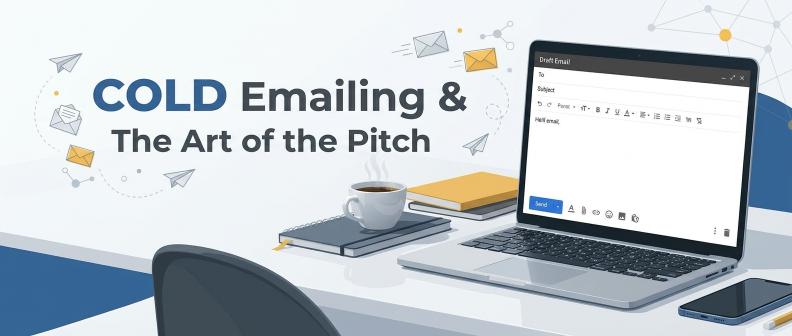
Most cold emails die in the first two seconds. The recipient scans the subject line, feels nothing, and deletes.
The average reply rate for cold email sits around 3-4%. That’s the benchmark for outreach that’s technically fine (verified list, decent subject line, personalization tokens filled in correctly). Senders who consistently land 8-10%+ replies aren’t doing something mysterious. They’re avoiding a short list of mistakes that quietly kill trust before the recipient finishes the first sentence.
This guide is for two groups. First, the professionals losing appointments they should be winning (the ones sending volume, following every “best practice” they were taught, and still hearing nothing back). Second, beginners who know they need to reach out to potential clients but have never been shown what separates a pitch that gets read from one that gets reported as spam.
Poor outreach doesn’t just cost you the deal in front of you. It costs you the next one too. A prospect who feels disrespected by your first message doesn’t just ignore you (they remember your name, and not in the way you want). The three principles below come from real cold pitches, real mistakes, and the reactions of the people on the receiving end. Get them right, and you fix the part of your outreach that no subject-line hack can save.
Principle 1 (Respect the Work (Don’t Downgrade))
The Mistake
A founder gets a DM from someone she’s never followed, who hasn’t engaged with a single post, opening with: “I went through your page and your branding isn’t working. You’re losing customers because of it.”
She didn’t ask for an audit. She never even got a compliment first. The sender skipped straight to the diagnosis, and the diagnosis assumed the founder hadn’t thought about her own brand (as if months of decisions, testing, and intent behind that “horrible” branding simply didn’t happen).
This is the fastest way to lose a prospect before you’ve said what you actually offer. Criticizing someone’s existing work without context reads as arrogance, not insight. It tells the reader you looked at the surface for ten seconds and decided you know their business better than they do.
The Strategy
Acknowledge the work before you suggest anything. You don’t need to fake enthusiasm: you need to show that you actually looked, and that you understand there was a reason things are the way they are.
Lead with an observation, not a verdict. “I noticed X” builds a bridge. “Your X is wrong” builds a wall. This is the core of cold email personalization done right: research isn’t decoration you sprinkle on top of a generic pitch (it’s what earns you permission to say anything critical at all).
If you genuinely believe there’s a gap, frame it as an addition to what already exists, not a correction of what’s broken. Respectful cold outreach doesn’t mean flattery. It means treating the recipient’s current choices as informed until proven otherwise.
Example
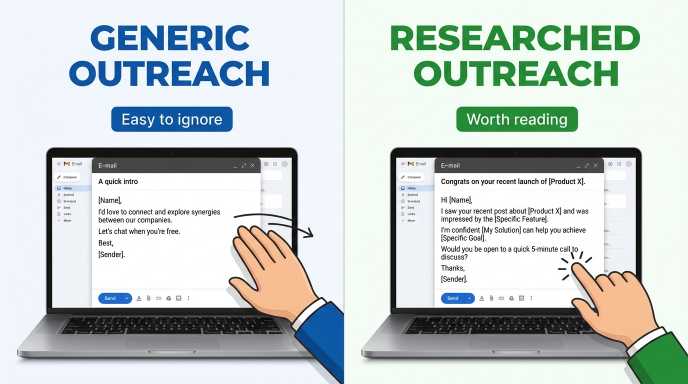
Bad: “Your branding is horrible and it’s costing you customers.”
Good: “Noticed your recent campaign push (here’s a case study showing how a team increased lead conversions from 3% to 11% during a similar launch) that could complement what you’re already doing.”
The second version does three things the first doesn’t: it proves you looked, it doesn’t assume failure, and it gives the recipient a reason to keep reading instead of a reason to block you.
Avoid Avoid the “Saviour Complex
The Mistake
Some pitches don’t criticize , they overcorrect the other way. “I can help you do this, I can help you do that, I’ll make sure everything gets sorted.” The sender hasn’t had a single conversation with the prospect yet, but they’re already promising to fix their entire operation.
It sounds generous. It isn’t. Speaking like you can solve every single problem for someone you’ve never worked with signals that you don’t actually understand their situation (because if you did, you’d know no single service fixes “everything”). It also sets an expectation you probably can’t meet, which means the relationship is doomed before it starts.
The Strategy
Realistic cold email promises beat claims that sound too good to be true every time. Instead of claiming you’ll transform the business, name one specific, measurable outcome tied to the exact problem you can solve.
This is where cold email credibility actually gets built (not through confidence, but through precision). A vague promise asks the prospect to trust you. A specific, provable one gives them a reason to. Setting expectations for cold outreach this way also protects you: you’re not on the hook for outcomes you never actually committed to.
Case Study
A deliverability specialist rewrote her opening pitch from “I’ll help fix your email marketing” to one sentence: “I helped a similar list cut bounce rates from 8% to 0.5% in six weeks (happy to show you how).” One claim, one number, one outcome. No promise to save the business. Just proof she’d solved the exact problem the recipient was likely facing, which is a far stronger opener than any offer to fix all their problems.
Don’t Demand Replacement
The Mistake
The version of cold outreach that completely misses the room doesn’t stop at criticism (it asks the prospect to fire someone). “Sack your brand person. Replace your current agency. Let me take this over instead.” The pitch positions the sender as a competitor to the prospect’s own team, and frames the ask as: prove you’re better than the person already doing this job.
Nobody enjoys being told their staff or vendor is the problem, especially by a stranger who’s never seen the work up close. It’s also a strange way to build trust (you’re essentially asking someone to make a costly, disruptive decision on your word alone, with zero track record between you).
The Strategy
A collaborative cold email strategy works because it removes the threat. Position yourself as a complement to the existing team, not a replacement for it. You’re not there to take someone’s job (you’re there to extend what the team can already do).
This is the difference between an ethical cold outreach approach and an overly pushy one: the goal is to add capacity or fill a specific skill gap, not to win an internal turf war you were never invited into. Proof of collaboration success (cases where you worked alongside an existing team rather than around it) does more to build confidence than any argument about why you’re the better choice.
Example
“We helped the marketing team at a similar company cut manual workload by 30% (without anyone on staff being replaced). We plugged into what they were already doing.”
That single line avoids the staff-replacement pitch entirely while still making the value obvious. It shows outcome, method, and respect for the existing structure in one sentence.
Genuine Interest (Engage First))
The Mistake
A prospect gets a message claiming to understand their business, deliver real results, and make their life easier. One problem: the sender has never followed them, liked a post, or commented on anything they’ve published. Zero engagement, zero history, zero proof the sender has ever actually looked at what the business does day to day.
This gap is obvious to the person receiving the message, even if it isn’t obvious to the person sending it. Claiming interest in someone’s work while showing no trace of that interest anywhere public is the outreach equivalent of saying “I love your restaurant” without ever having eaten there.
The Action Plan
Personalized cold email starts before you write a single word of the message (it starts with research before pitching). Spend five minutes on the recipient’s public activity before you touch the keyboard. What did they post recently? Did their company just launch something, hire for a new role, or hit a visible milestone?
Engage before outreach in a way that’s real, not performative. You don’t need to comment on every post for a month. You need one specific reference that proves you followed the client’s activity closely enough to notice something worth mentioning.
Tutorial: The Opening Line Formula
Build your first sentence from one of three triggers:
- Observation (something concrete you noticed: “Saw your team just moved into the EU market…”)
- Compliment tied to specifics (pointing directly to why a post stood out, rather than saying “great content”, and explaining why it’s relevant to your pitch)
- Trigger event (a launch, hire, funding round, or public milestone that creates a natural reason to reach out now)
Pick one trigger, write one sentence, and make sure that sentence contains details specific to this recipient (details that wouldn’t apply if sent to the next fifty people on your list).
Offer Value Before Asking (Free Trial Done Right)
The Mistake
Some pitches ask for payment, commitment, or trust upfront, with nothing to back the ask except the sender’s word. No sample, no proof, no small taste of what working together would actually look like. The recipient is expected to take a leap based purely on confidence.
That’s a hard sell from a stranger. Demanding commitment before demonstrating value flips the natural order of trust-building, and most prospects will simply pass rather than gamble on an unproven claim.
The Action Plan
This is reciprocity in cold email working as it should: give something useful first, and the ask that follows feels earned rather than presumptuous. You don’t need to give away your entire service for free (you need to give value first in a way that costs you under thirty minutes while proving you can deliver measurable improvements).
A sample audit cold email works well here. A short teardown of one page, one campaign, or one metric shows competence without requiring a contract. Think of it as a taste test: a small, real example of the work, offered before the ask, not instead of eventual payment.
Case Study
One mentee wanted to break into email marketing but had no track record to point to. Instead of pitching a paid retainer cold, she offered three months of hands-on email marketing work to a business she wanted to work with, with payment discussed only once results were visible. By the time the free period ended, the results spoke for themselves, and the conversation about payment happened on her terms , because she’d already proven the value instead of just claiming it.
Frameworks That Work in 2026
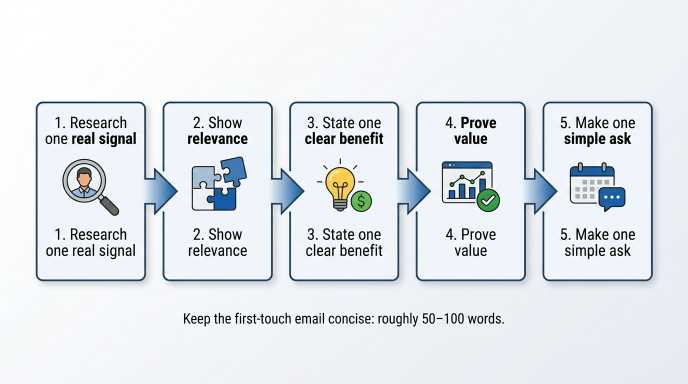
Once the five principles above are in place, a repeatable framework keeps every message consistent instead of reinventing the pitch from scratch each time.
AIDA-R Framework
A cold-email spin on the classic sales structure, with one addition:
- Attention (a subject line and opener specific enough to stop the scroll)
- Interest (the observation that proves you did the research)
- Desire (the one benefit connected to the problem you spotted)
- Action (a single, low-friction CTA)
- Relevance (the piece most senders skip: a line that ties the ask directly back to something true about this specific recipient, not a generic segment)
Relevance is what separates a template that happens to include a first name from a message that actually reads like it was written for one person.
Bounce Zero 5-Part Framework
A simple checklist structure for building the message itself:
- Subject line (specific, avoiding misleading claims)
- Opening line (about the recipient, not the sender)
- Value proposition (one benefit, tied to the opener)
- Social proof (a real result, kept to one line)
- CTA (one question, easy to answer)
Five parts, one idea each. If any part tries to do the job of two, cut it back down.
ColdCraft Behavioral Drivers
Behind every framework sits the same three psychological levers:
- Reciprocity (give something (insight, proof, a sample) before you ask for anything)
- Social proof (a specific, relevant result outweighs a general claim of expertise)
- Curiosity gap (leave the recipient wanting the next piece of information, rather than handing over everything in the first message)
Use these to sanity-check a draft before sending: does it give before it asks, does it prove instead of claim, and does it leave the recipient with a reason to want to hear more?
Put the Principles Together
None of these five mistakes are really about copywriting. They’re about how you treat someone you’re asking for time from. Respect the work already in front of you. Make promises you can actually keep. Offer to add, not replace. Show you’ve actually paid attention. Give before you ask.
Fix those five, and the tactical stuff (subject lines, CTAs, follow-up timing, whichever framework you pick to organize it all) has something solid to sit on top of. Skip them, and no amount of clever wording saves a pitch that made the prospect feel judged, oversold, ignored, or threatened in the first three seconds.
Tutorials & Examples
Before vs. After Rewrite
Bad: “Exciting opportunity to improve your email deliverability!”
Good: “Saw your post on outbound sequencing: here’s how we cut bounce rates from 8% to 0.5%.”
The bad version could land in any inbox on the planet. It announces excitement about nothing specific, promises improvement without proof, and gives the recipient zero reason to believe this message was written for them.
The good version does the opposite on every count. It references something the recipient actually posted, which proves a human read their content before hitting send. It skips the adjectives entirely and replaces them with a number. And it leads with a result instead of an offer, so the recipient’s first reaction is curiosity about the number, not suspicion about the pitch.
Run every subject line and opener through the same test: could this sentence exist without the recipient’s name attached, and still make sense? If yes, rewrite it.
The 72-Word Rule
Cold email reply rates track closely with conciseness. Most first-touch messages perform best somewhere between 50 and 120 words (enough room to establish relevance, name one benefit, and ask one question, without asking the recipient to do the work of reading a memo from a stranger).
Treat 72 words as your target, not your ceiling. That’s roughly four to five short paragraphs: one line of context, one line connecting that context to a problem, one line of value, one line of ask. If a draft runs long, the fix usually isn’t tighter sentences, it’s cutting whichever paragraph doesn’t directly support the ask.
Risks and Considerations
Careless outreach damages reputation. A copy-pasted pitch that shows no research doesn’t just get ignored (it gets remembered, and not in your favor). Prospects talk to each other. A careless DM today can quietly close doors you haven’t even knocked on yet.
Timing matters. Holidays and other low-attention windows aren’t the moment to fill someone’s inbox with a cold pitch. A message that would land fine on a regular Tuesday reads as tone-deaf when it shows up during a break, a crisis, or a moment the recipient is completely disengaged.
Proof beats promises. Every risk above traces back to the same root cause: treating the pitch as a numbers game instead of a first impression. A specific result, shown rather than claimed, builds more credibility in one line than an entire paragraph of assurances ever will.
FAQs
What Is the Ideal Cold Email Length?
Most first-touch cold emails work best between 50 and 100 words. That’s enough space to show relevance, state one benefit, and make one ask, without burying the point under a company history nobody asked for.
Do Free Trials Work in Cold Outreach?
They can, but only when they’re small and specific. A short audit, a sample report, or a scoped-down preview of the work gives the recipient proof without asking them to commit to anything. An open-ended “let’s work together for free and see” invites confusion instead of trust.
How Do I Personalize at Scale?
Personalization at scale isn’t about writing a hundred unique emails from zero: it’s about building a repeatable process for finding one real signal per recipient: a recent post, a hire, a launch, a public milestone. Automate the research step where you can, but keep a human checking that the connection between the signal and the pitch actually makes sense before anything sends.
What Subject Lines Get Opened?
Subject lines that reference something real about the recipient outperform subject lines that promise something about your product. A line tied to a specific situation, question, or piece of content beats a generic teaser almost every time, because it gives the recipient a reason the message concerns them specifically, not just a reason to be curious.
Every mistake covered in this guide comes back to the same root problem: treating the recipient as a target instead of a person. Respecting the work already in front of them, keeping promises realistic, offering to add value instead of replacing what’s already there, doing the research before reaching out, and proving value before asking for it: none of that is complicated. It’s just rarely done.
Frameworks won’t fix a pitch built on the wrong instincts, but once the instincts are right, a proven structure keeps every message consistent instead of forcing a rewrite from scratch each time you sit down to pitch someone new.
Cold outreach isn’t going away (it’s getting harder to fake). Inboxes filter more aggressively, recipients spot templates faster, and the gap between lazy outreach and researched outreach keeps widening. That gap is the opportunity. The senders willing to do the work before they hit send are the ones who’ll keep getting replies while everyone else gets deleted in two seconds.