

Introduction
Nigeria’s smartphone market runs on a simple reality: most buyers aren’t shopping for a flagship, they’re shopping for a phone that survives the day. Between irregular power supply, data-heavy apps, and a naira that keeps testing new lows against the dollar, “budget” isn’t a compromise here , it’s the actual market.
That’s exactly why budget smartphones matter more in Nigeria than in most places. A phone in the ₦150,000–₦200,000 range now has to double as a work tool, a POS terminal, a classroom, and a camera for the side hustle. Get the wrong one, and you’re not just stuck with a slow phone , you’re stuck with a business risk.
Vendors and telecom partners feel this shift too. Brands that used to chase the premium buyer are now fighting hardest over the sub-₦200,000 segment, because that’s where the volume actually is. The result: better specs land at this price point every year, and buyers who know what to look for can walk away with a phone that punches well above its price tag.

What to Look for in a Budget Smartphone
Battery Capacity
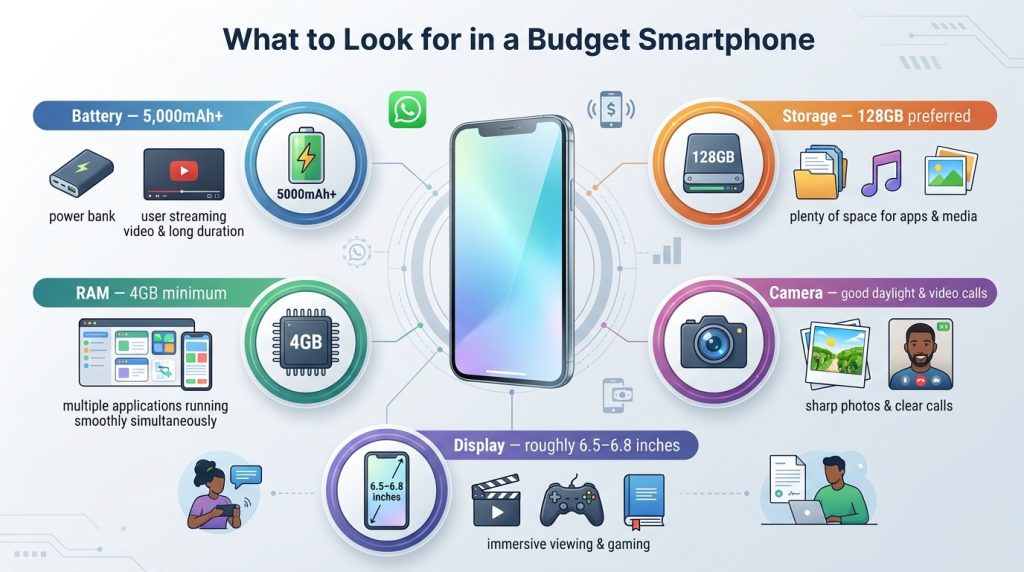
In a country where power supply can’t be counted on, battery life isn’t a nice-to-have , it’s the single feature that determines whether a phone survives a full day of actual use. Look for at least 5,000mAh. Anything smaller means charging twice a day, which isn’t realistic if you’re out running errands, working a shift, or simply don’t have steady access to an outlet.
RAM and Storage
4GB of RAM is the floor for smooth multitasking , WhatsApp, Instagram, and a banking app open at once shouldn’t cause a phone to choke. Storage matters just as much: 64GB fills up fast once photos, videos, and app updates start stacking, so 128GB is the safer baseline if your budget allows it.
Camera Quality
Nobody expects flagship-level photography at this price point, but a decent budget camera should still handle daylight shots, video calls, and social media content without a fight. AI-assisted processing has made a real difference here , it’s often the gap between a photo that looks washed out and one that actually looks usable.
Display
Screen size affects everything from video calls to reading long WhatsApp forwards. Most solid budget phones now sit between 6.5 and 6.8 inches, which is large enough for comfortable streaming and browsing without making the phone unwieldy in one hand.
Software Experience
A phone that runs a lighter, well-optimized version of Android will often outperform a phone with better paper specs but bloated software. Check how a brand handles updates and interface speed, not just the chipset name on the box.
Why Budget Smartphones Are Improving
Increased Competition
Tecno, Infinix, Samsung, Xiaomi, Itel, and now a wider field including OPPO, Vivo, and Huawei’s budget lines are all fighting for the same Nigerian buyer. That competition is the biggest reason budget phones keep getting better , no single brand can afford to stand still while four others are racing to add specs at the same price.
Better Processors
Chipsets that used to be reserved for mid-range phones are now standard in budget models. That translates directly into smoother app switching, less lag when multiple tabs are open, and phones that don’t slow to a crawl after a year of use.
Improved Camera Technology
AI-powered image processing has trickled down from flagship phones into budget lines faster than almost any other feature. It’s the single biggest reason a ₦150,000 phone today takes noticeably better photos than a similarly priced phone did three years ago.
Larger Batteries
Manufacturers have clearly clocked what Nigerian buyers actually need: batteries in the 5,000–6,500mAh range are now common even in entry-level models, a direct response to a market where power reliability can’t be assumed.
Top Budget Smartphones in Nigeria (2026)
Tecno Spark 30 Pro
Best for students and creators. A 6.78-inch AMOLED display, a MediaTek Helio G100 chipset, and a 108MP main camera put this a step above the typical budget phone , the trade-off is a price closer to ₦230,000–₦250,000, so it fits students and content creators willing to stretch the budget a little further for a screen and camera that actually look premium.
Infinix Hot 60i
Best for gamers and multitaskers. The Hot 60i pairs a large HD+ display with a 5,160mAh battery and a 50MP main camera, all comfortably under ₦170,000. It’s the phone Infinix built specifically for buyers who spend hours in mobile games or social apps and need the battery to keep pace.
Xiaomi Redmi 15C
Best for everyday users. At around ₦178,000, the Redmi 15C brings a 6,000mAh battery, 33W fast charging, a 50MP main camera, and a spacious 6.9-inch display. Xiaomi’s MIUI interface also adds customization options that most budget phones skip entirely, making this a strong all-rounder for daily use.
Samsung Galaxy A07
Best for brand reliability. Priced around ₦158,000, the Galaxy A07 leans on what Samsung does best: a clean One UI experience, dependable long-term software support, and a 50MP camera that’s well optimized for balanced, everyday shots. For buyers who prioritize trust in the brand over chasing the newest spec sheet, this is the safe pick.
Itel P65
Best for ultra-budget buyers. At roughly ₦147,000 for the 8GB/128GB variant, the Itel P65 undercuts nearly everything else on this list while still offering a real 8GB of RAM. It won’t win on camera quality, but for buyers whose priority is simply a reliable phone at the lowest possible price, it’s hard to beat.
OPPO A6x
Best for entertainment. A 6.75-inch display and a massive 6,500mAh battery make the OPPO A6x, priced around ₦182,000, a strong pick for anyone who spends most of their screen time on video and social content. Released in December 2025, it’s one of the newer entrants in this price bracket and doesn’t get the attention it deserves.
Vivo Y18
Best for business users. With 4GB, 6GB, and 8GB RAM variants and a 5,000mAh battery built for low power draw, the Vivo Y18 (around ₦169,000) is designed to last through a full workday of calls, emails, and scheduling without needing a midday charge , a genuine advantage for anyone using their phone as a business tool.
Nokia C32
Best for durability. The C32’s appeal isn’t about specs , it’s a straightforward 6.5-inch display, a 5,000mAh battery, and Nokia’s reputation for phones that keep working long after flashier devices have been retired. Pricing varies significantly between vendors, so it’s worth comparing a few listings before buying, but the durability trade-off is consistent across the board.
Umidigi G5 Mecha
Best for field workers. This is a genuinely rugged phone , IP68 and IP69K rated, with MIL-STD durability certification, a 6,000mAh battery, and a 50MP camera, priced around ₦150,000. For anyone working outdoors, on a construction site, or anywhere a dropped or dusty phone is a real risk, it’s built for exactly that environment in a way the rest of this list isn’t.
Huawei Nova Y71
Best for stylish users. The Nova Y71 pairs a 6.75-inch display with a 6,000mAh battery and a 48MP triple camera setup in a design that stands out from the usual budget-phone look. One important caveat: it runs EMUI without Google Mobile Services, meaning no Play Store out of the box , a real consideration for anyone who relies on Google apps day to day, and worth confirming before buying.
Case Study: Student vs Business Owner Needs
Example: Tecno Spark vs Samsung Galaxy A15
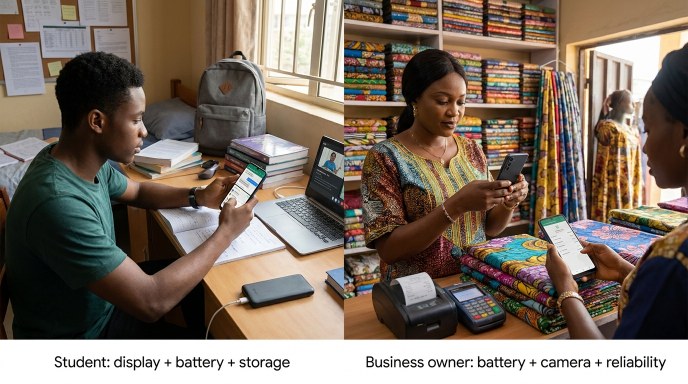
Two buyers, same ₦150,000–₦200,000 budget, two completely different phones , and that’s the point. What counts as the “best” budget smartphone depends entirely on who’s buying it.
Take a student. Budget is tight, screen time is high, and the phone doubles as a study tool, a camera, and the main entertainment device. A Tecno Spark model fits that brief well: a large 6.5–6.8-inch display for reading and video, a battery built to survive a full day between classes, and a price that leaves room in the budget for data and accessories. Tecno also wins on availability , spare parts and repairs are easy to find in almost any Nigerian city, which matters when a student can’t afford weeks without a working phone.
Now take a business owner. The priorities flip. A Samsung Galaxy A15 costs more for similar core specs , a 6.5-inch Super AMOLED display, a MediaTek Helio G99 chipset, and a 5,000mAh battery , but the real value is in what Samsung backs it with: multiple years of guaranteed software updates and One UI’s cleaner, more stable day-to-day experience. For someone using their phone to run WhatsApp Business, mobile banking, and client calls, that long-term software support is worth paying extra for. A crashed or outdated phone mid-transaction costs more than the price difference ever would.
Comparing the two head-to-head:
- Budget: Tecno Spark models generally undercut the Galaxy A15 by ₦20,000–₦50,000 depending on the variant.
- Performance: Both run comparable MediaTek chipsets at this tier , the difference shows up more in software optimization than raw power.
- Battery life: Close to a wash. Both brands ship 5,000mAh+ batteries as standard at this price point now.
- Software support: Samsung’s update commitment is the clearer winner , Tecno’s HiOS updates are less predictable long-term.
- Everyday use: Spark edges ahead for pure entertainment and battery stamina; the Galaxy A15 edges ahead for anyone treating the phone as a business tool.
Neither phone is objectively “better.” The right answer depends on whether the phone needs to survive a semester or run a business.
Tutorials & Buying Guides
Compare Specifications
Before comparing prices, put the actual specs side by side: RAM, storage, chipset, battery capacity, and display type. It’s easy to get pulled in by a low price tag and miss that the phone next to it offers 2GB more RAM for a small difference in cost. A five-minute spec comparison saves months of regret.
Read Reviews
Specs on paper don’t always match real-world performance. YouTube demonstrations are especially useful here , watching someone actually open apps, switch between them, and use the camera in real lighting tells you more than a spec sheet ever will. Reddit discussions are worth a scan too, since they tend to surface the actual complaints owners have after a few months of daily use, not just launch-day impressions.
Avoid Extremely Cheap Deals
If a listing is priced noticeably below every other seller for the same model, treat that as a warning sign, not a bargain. It usually means a refurbished unit sold as new, a counterfeit device, or a phone with a blacklisted IMEI. Always confirm IMEI status and originality before paying, especially when buying from an individual seller rather than a store.
Check Software Updates
A phone that stops receiving security patches after a year becomes a liability, not just an inconvenience. Check how many years of OS and security updates a brand commits to before buying , this single factor often matters more for long-term usability than the chipset does.
Where to Buy Budget Smartphones in Nigeria
Online Stores
Jumia and Konga remain the most straightforward starting points , established return policies, visible customer ratings, and enough sales volume that pricing tends to stay competitive. Cybervilla has also built a solid reputation among Nigerian buyers specifically for phones and accessories, often with faster delivery in major cities.
Physical Phone Markets
Computer Village in Lagos and similar hubs like Slot’s retail outlets let buyers physically inspect a device, test the camera and screen, and negotiate price on the spot , something no online listing photo can replace. The trade-off is that markets require more caution: bring someone experienced if it’s your first visit, and always test the phone fully before paying.
Brand Retail Stores
Buying directly through Samsung, Tecno, or Infinix’s official stores costs a little more, but it guarantees an authentic device and a valid warranty from day one. For buyers who’ve been burned by a fake or reconditioned phone before, that guarantee alone is often worth the premium.
Risks and Considerations
Warranty matters more than the price tag suggests. A phone that’s ₦20,000 cheaper but comes with no warranty is a gamble, not a deal. If the screen, battery, or charging port fails in month three, that “savings” disappears fast into repair costs. Always confirm warranty length and what it actually covers before handing over cash.
Fake and reconditioned phones are a real risk in this price range. Budget models are the most commonly counterfeited or passed off as new when they’re actually refurbished. Check the IMEI against the box and the phone’s settings menu, inspect for signs the device has been opened before, and buy from a seller who’ll let you verify authenticity on the spot.
Prices move , a lot, and inconsistently. Naira depreciation and shifting import costs mean phone prices in Nigeria can swing noticeably within a few months, and even reputable-looking sources online often quote wildly different figures for the exact same model. Treat any listed price as a starting point for comparison, not a fixed number, and check two or three current listings before deciding a deal is actually good.
FAQs
What Are the Top 5 Budget Smartphones Under ₦150k?
Worth knowing upfront: ₦150,000 is a tighter ceiling in 2026 than it used to be, and several well-known budget models have already crept just above it. Right now, the Itel P65 (around ₦147,000) and the Umidigi G5 Mecha (around ₦150,000) are among the few current, reliable options that actually fit under that line. If the budget can stretch to ₦170,000–₦180,000, the field opens up considerably , that’s where phones like the Infinix Hot 60i, Tecno Spark 40C, and Samsung Galaxy A07 come into play.
Which Budget Smartphone Has the Best Battery Life?
The OPPO A6x and Umidigi G5 Mecha both stand out here, with battery capacities in the 6,000–6,500mAh range. For a phone that lasts closer to two days on moderate use, the Vivo Y18 is also a strong pick, thanks to software tuned specifically for low power draw rather than just a bigger battery.
Is ₦150k Enough to Buy a Good Smartphone in Nigeria?
It’s enough, but the margin is thinner than it was even a year ago. At exactly ₦150,000, expect solid basics , a large display, a battery that survives the day, and a usable camera , without much room for extras like AMOLED screens or flagship-grade chipsets. Stretching to ₦180,000–₦200,000 buys noticeably better hardware across the board.
Which Brand Makes the Best Budget Smartphones in Nigeria?
There’s no single winner , it depends on what matters most. Tecno and Infinix dominate on price-to-spec value and battery life. Samsung wins on software longevity and resale trust. Itel wins on raw affordability. The “best” brand is really the one whose strengths match what the buyer actually needs day to day.
Do Budget Phones Support 5G?
Mostly not yet, and that’s fine for most buyers. Nigeria’s 5G rollout is still limited outside major cities, so a 4G budget phone won’t feel like a compromise for the average user right now. A handful of models in this price range are starting to add 5G, but it’s rarely worth paying extra for a network most people can’t fully use yet.
Across every model covered here, the same pattern holds: no single phone wins on every metric, and the “best” pick always comes back to what the buyer actually needs. Students lean toward big screens and battery stamina. Business owners lean toward software support and reliability. Ultra-budget buyers just want something that works without surprises.
Don’t chase specs for their own sake, and don’t assume the most expensive option in this price bracket is automatically the safest choice. Match the phone to the actual use case , screen time, work demands, camera needs, budget ceiling , and the right pick usually becomes obvious fast.
Budget smartphones in Nigeria aren’t slowing down either. Competition between Tecno, Infinix, Samsung, Xiaomi, and the rest keeps pushing better specs into this price bracket every year, which means the phone that counts as a smart buy today will likely look modest in twelve months. That’s good news for buyers , it just means the research described in this guide is worth repeating each time an upgrade is due, not a one-time exercise.
….